
ChatGPT watermark in the EU: what it means for your firm
OpenAI is adding an invisible watermark to ChatGPT text in the EU. Why what matters for your business is who checks what you publish, not the mark itself.

Blog · · 6 min · digizone team
OpenAI is going to put an invisible watermark on the text ChatGPT produces for users in the European Union. For a business that already writes product pages, emails or posts with AI, the ChatGPT watermark changes little day to day. What it does bring into focus is the question that really matters: who checks what you publish and answers for it.
In short
- On 5 October 2026 OpenAI announced it will add an invisible watermark, called textGrain, to ChatGPT and Codex text in the European Union over the coming weeks.
- The mark cannot be seen when reading or copying the text, and the detector will not be public: at first only researchers and expert organisations can apply for it.
- In OpenAI's own tests, detection on 400-token texts drops from 92% to 66% when one word in ten is swapped for a synonym: the mark does not prove who wrote a text, or whether it is true.
- For a small business, the useful step is deciding which texts are written with AI and who checks them before they go out.
What OpenAI has announced
A watermark is a signal that lets you tell later where a piece of content came from. On 5 October OpenAI announced it will add its own, called textGrain, to ChatGPT and Codex text in the European Union "over the coming weeks", according to BleepingComputer. It is not a hidden symbol: the model slightly adjusts its choice of words, leaving a statistical pattern that a detector can look for. Nothing shows when you read or copy the text. Outside the EU it will not be the default for now, and anyone using the API, the connection software uses to talk to the model, can switch it on for some models, though it comes turned off.
The detector will not be public. Hipertextual explains that, at first, OpenAI will only accept applications from researchers and expert organisations, and links the change to the EU's AI rules. Article 50 of the AI Act, in force since 2 August 2026, requires those offering systems that generate text to mark the output in a machine-readable way.
The product pages of a bike shop

Imagine you run a bike shop with a repair workshop. For months ChatGPT has been helping with the product pages on your website, the monthly newsletter and replies to reviews. You paste in a few details from the supplier, it hands back something that reads well, and you publish it between one repair and the next.
One Tuesday a customer walks in, phone in hand. The page for one bike says it has hydraulic brakes, and it does not. Nobody meant any harm: the text came out that way and nobody checked it against the catalogue. That same afternoon you read about the watermark and wonder whether people will now be able to tell that a machine writes your copy.
Why do so many businesses write with AI without any rules?
The scene is made up, but it is a familiar one. AI slipped into small businesses through the back door: someone tried it for a tricky email, it worked, and it stayed. Nobody decided which texts it is used for, what gets pasted into it or who looks at the result before it goes out.
That is understandable. When there are three of you, nobody writes a usage manual. The trouble starts as volume grows: twenty product pages a month, a newsletter, replies to customers. Every text that goes out without a second read is a small gamble.
What an unchecked text can cost you

The watermark is not the risk. What costs you is a wrong spec on a product page, a promise you cannot keep in a reply, or a newsletter that sounds just like a competitor's. You pay for that in returns, in annoyed customers and in trust.
Nor is the mark a reliable way to know what a machine wrote. OpenAI's own evaluation, as reported by BleepingComputer with a 1% false-positive target, gives these figures (a token is a fragment of a word that the model works with):
- 200-token answers on psychology: around 80% are detected.
- 400-token answers on psychology: around 95%.
- 400-token texts with 10% of the words swapped for synonyms: detection falls from about 92% to 66%; with 25% swapped, to 17%.
OpenAI also warns that finding no mark does not prove a person wrote the text, and that finding one does not reveal who generated it or how much was edited afterwards. Hipertextual adds that it does not confirm the content is accurate either.
What should a small business that writes with ChatGPT do?
Nothing urgent, and certainly not hide it. What is worth an afternoon is writing down how your business uses AI. One page is enough:
- List the texts that already go out with AI help: product pages, emails, social posts, review replies, quotes.
- Decide where it is used and where it is not. Anything that commits the business, such as prices, delivery times or terms, deserves extra care.
- Name the person who checks each type of text before it is published, and what they check: facts, prices, tone.
- Agree on what never gets pasted into an AI tool, such as customers' personal details or contracts.
- Review the page every few months: the tools change quickly, and so do the rules.

As for the law, Article 50 says that anyone who publishes AI-generated text to inform the public on matters of public interest must disclose that it was AI-generated, unless the text has gone through human review or editorial control and someone takes responsibility for publishing it. If you are unsure about your own case, ask an adviser. Either way, checking your texts is good practice.
How we help at digizone
At digizone we offer technology consulting: we sit down with you, look at where AI fits in your business and where it does not, and help you put tools and rules in order so your team uses it sensibly. If you need a tool of your own, we build it.
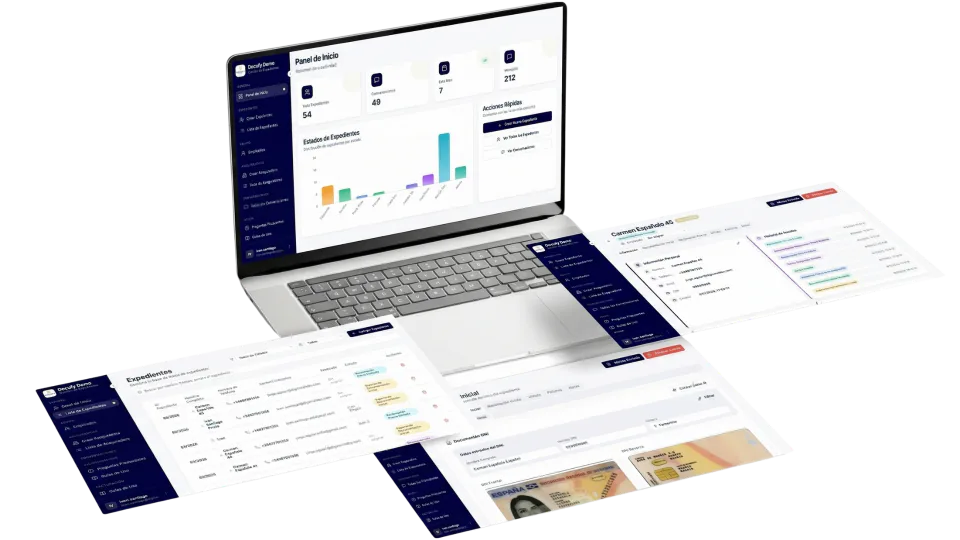
One example of AI doing the writing inside a business is Docufy. Law firms specialising in road traffic accidents were spending much of their time on manual work, such as gathering paperwork or drafting documents. We built a platform with automations and with AI that generates the documents, where each firm can use its own templates. What the professionals value most is the time they save gathering paperwork and producing documents.
A first rule, not a manual
You do not need a forty-page policy. The idea behind an MVP, a minimum viable product, works here too: start with the smallest thing that already solves a real problem, and improve it as you use it.
In the bike shop, that first version would be a rule for product pages: AI drafts them, and before anything goes live someone checks every spec against the supplier's catalogue. Later, a small tool could do that check on its own and flag anything that does not match. The newsletter and the review replies would follow.
If you would like to see how it would work for you, our free workshop, in Spanish, walks through it step by step.
Frequently asked questions
What is textGrain, the ChatGPT watermark?
It is the technology OpenAI will use to mark ChatGPT and Codex text in the European Union, as announced on 5 October 2026. The model slightly adjusts its choice of words, leaving a statistical pattern that a detector can recognise later. It adds no hidden symbols or characters, and nothing shows when you read or copy the text.
Will people be able to tell my company's texts are written with AI?
Not by reading them: the mark is invisible. OpenAI's detector will not be public at first either; only researchers and expert organisations can apply for it. And OpenAI itself admits detection struggles with short or edited texts. Rather than worrying about the mark, make sure every text you publish passes through someone who checks the facts.
Do I have to say a text was written by AI?
Article 50 of the EU AI Act says that anyone who publishes AI-generated text to inform the public on matters of public interest must disclose it, unless it has gone through human review or editorial control and someone takes responsibility. The duty to mark the text falls on whoever provides the system, such as OpenAI. If you are unsure about your own case, ask an adviser.
Does the watermark prove a text was written by a machine?
Not entirely. In OpenAI's tests on 400-token texts, detection falls from 92% to 66% when one word in ten is swapped for a synonym. OpenAI also warns that finding no mark does not prove a person wrote the text, and that finding one does not reveal who generated it or how much it was edited.
How do I start putting some order into AI use in my business?
With a simple page: which texts are written with AI help, where it is not used, who checks each type before it goes out, and what is never pasted into these tools, such as customers' personal details. Start with the kind of text you publish most, make sure the rule works, then extend it bit by bit.
Sources
About digizone
digizone is a custom software development company founded in 2019, with offices in Barcelona and Cartagena (Spain). We design and build mobile apps, web applications, CRM/ERP systems and AI automation for startups, SMEs and enterprises. Meet the team

Other articles
Don't get left behind: if you want to keep up to date with the fast-moving technology sector, take a look at the following articles:

Meta's new AI agent for small businesses needs your data
Meta has launched Muse for Small Business, an AI agent that reads a company's own tools. Why well-organised business data matters more than the agent itself.
Read more »
Only 4.1% of Spain's industrial SMEs use AI: how to start
The IndesIA Barometer 2026 finds that just 4.1% of Spain's industrial SMEs use artificial intelligence. What it means and where to start.
Read more »
How mobile apps improve your business performance
Businesses in this era are increasingly turning their attention towards mobile apps for the improvement of their business process, overall performance, and customer engagement.
Read more »Contact us
Do you have any questions? Would you like to schedule a call or a meeting? We would be happy to address any concerns and start working with you. The perfect digital solution for your business is just around the corner.
Subscribe to the newsletter
Discover the digital future by subscribing to our exclusive newsletter! Stay updated on the latest trends and developments in the world of technology. Don't miss the chance to be the first to learn about the innovations that are transforming the present! Subscribe now.