
Muse Ember and the cost of an AI agent in your business
Meta launches Muse Ember, a small model for the tasks agents repeat. The cost of an AI agent is measured per finished task, not per token.

Blog · · 6 min · digizone team
The cost of an AI agent, the software that carries out chains of tasks for you, such as reading an email and drafting a reply, depends heavily on the model inside it. Meta has just launched Muse Ember, a small, cheap model built for exactly those repetitive tasks. For a small business, the news is a prompt to ask a simple question: what does each task your agent finishes actually cost?
In short
- On 9 November Meta unveiled Muse Ember, its smallest model, built for the tasks an AI agent repeats all day, such as extracting data or reading long documents.
- Meta charges $0.10 per million input tokens and $0.50 per million output tokens for requests of up to 200,000 tokens.
- According to Artificial Analysis estimates reported by Interesting Engineering, Muse Ember works out at about $0.14 per task, against about $0.41 for Claude Haiku 5.5.
- The price per token is not the whole cost: retries, manual corrections and long inputs add up too, as VKTR points out.
- For a small business, the useful step is knowing what each finished task of its agent costs, and trying the most frequent one on a smaller model before paying for a large one.
Muse Ember, Meta's small model for agents
Meta unveiled Muse Ember on 9 November as its smallest and most efficient model. In its announcement it pitches it at the work agents repeat all day: calling other tools, coding subtasks, routing requests, extracting information and reading long documents, among other uses. Developers can use it as muse-ember-1.0 in Muse Code and the Meta Model API, and Meta says it is also on Google Cloud and Oracle Cloud. The announcement does not say which countries it covers.
Prices are measured in tokens, the chunks of text these models use to count what they read and write. According to Meta, for requests of up to 200,000 tokens it charges $0.10 per million input tokens and $0.50 per million output tokens; above that size, the price triples. Meta claims it offers more intelligence per dollar than Anthropic's Claude Haiku 5.5 and OpenAI's GPT-6 Luna; these are Meta's own figures.
Interesting Engineering also reports a cost-per-task estimate from Artificial Analysis, a firm that compares models. These are that firm's estimates, not Meta's prices:
- Muse Ember: about $0.14 per task.
- Claude Haiku 5.5: about $0.41 per task.
- Muse Spark 1.3, a larger Meta model: about $2.39 per task.
Julián's quotes

Imagine Julián runs a removals company with two vans. Quote requests reach him by email: a three-bedroom flat, a fourth floor with no lift, a piano, a date that keeps shifting. A few months ago he set up an AI agent that reads each email, pulls out the list of furniture, the floors and the dates, and leaves him a draft quote.
To play it safe, he picked the most powerful model his provider offered. It works. But at the end of the month the bill arrives as a single total, and Julián has no idea what each quote cost him or how many drafts he had to redo by hand.
Why is an AI bill so hard to read?
Because it is charged in a unit nobody uses in their business. A small business owner thinks in quotes, orders or invoices; the provider charges per million tokens. In between sit steps you never see: the agent reads the whole email, sometimes repeats a step that went wrong, checks another tool and writes a long reply.
That usage varies a great deal from one run to the next. VKTR cites a 2026 study by Stanford, Michigan and MIT which found that token use on agentic coding tasks varied up to 30 times between runs of the same task, and that spending more tokens did not lead to better accuracy. With a price per token in front of you, it is easy to think you know what you are paying. You do not.
A large model for small jobs

Pulling a furniture list out of an email is a small, repetitive job, the kind of work Meta pitches Muse Ember at. Paying for it with the most expensive model is like sending the big lorry to deliver a single box. While volumes are low, you barely notice. Once the agent handles hundreds of quotes a month, that gap per task multiplies.
And there is a cost that never shows up on the provider's bill: the time of whoever fixes the output. VKTR mentions a Workday study from January 2026, with 3,200 respondents, which found that close to 40% of the time AI saves is lost to reworking its output. If Julián touches up every few drafts by hand, that time is part of what the agent costs too.
How do you work out the cost of an AI agent per task?
You do not need to be a developer to do the maths. You just need to swap the question from what a token costs to what each finished, correct task costs:
- Write down the tasks your agent does, one per line: reading the email, pulling out the details, drafting the quote.
- Ask whoever set it up to log the usage of each task for a month, not just the bill total.
- Divide what you pay by the tasks completed, and add the time you spend fixing the ones that go wrong.
- Pick the most frequent task and try it on a smaller model, using real cases from the previous month.
- Compare results and cost, and keep the large model only for what the small one cannot handle well.

Meta itself suggests pairing Muse Ember with Muse Wonder, its model for the hardest problems. The idea works with any provider: a small model for the repetitive work and a large one for the tricky cases. VKTR sums it up with an adviser's tip: start from the cheapest model that clears the bar.
Artificial intelligence with clear numbers
At digizone, before choosing a model, we get to know your business: which tasks repeat, how many times a day and what happens when they go wrong. With that in hand, we design and implement the artificial intelligence that fits, with every task measured so you know what it costs and what it brings in.
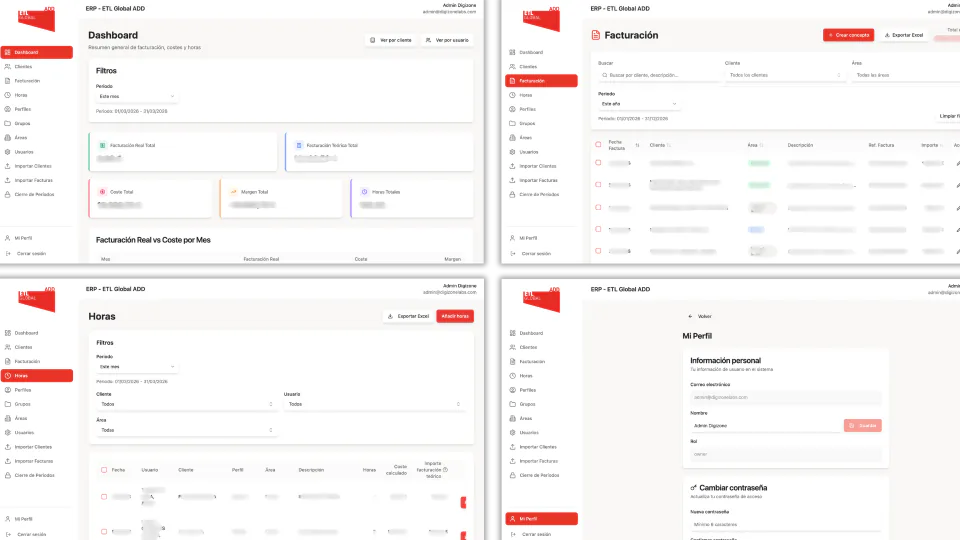
Knowing what each unit of work costs is what links this topic with ETL. There, hours, professional roles and invoicing sat in separate systems, and analysing real costs was hard. We built a web ERP where the team logs its hours by client, project and role, the platform works out the costs and matches them against what has been invoiced, and management tracks profitability on dashboards and spots deviations.
One type of quote, one month of figures
Julián does not need to rebuild his agent. His first version would be to measure a single type of quote, flat removals, for a month: what each one costs, how many he corrects and how long it takes him. With that figure in hand, he can try the data extraction on a smaller model and compare. If it does the job just as well for less, he rolls it out to the rest of his quotes.
If you would like to see how it would work for you, we walk you through it step by step (in Spanish).
Frequently asked questions
What is Muse Ember?
It is Meta's smallest AI model, unveiled on 9 November 2026. It is built for the tasks agents repeat a lot, such as extracting information, routing requests or reading long documents. It is available through the Meta Model API and Muse Code, and Meta says it is also on Google Cloud and Oracle Cloud. The announcement does not say which countries it covers.
How much does Muse Ember cost?
According to Meta, for requests of up to 200,000 tokens it costs $0.10 per million input tokens and $0.50 per million output tokens. Above that size, prices rise to $0.30 and $1.50. A token is a chunk of text: models count what they read and write in tokens.
Why is the price per token not enough to know what an AI agent costs?
Because an agent does not make a single request per task. It may read long texts, check other tools or repeat a step that went wrong. On top of that, the time someone spends fixing its mistakes costs money too. That is why it pays to measure what you spend on each finished, correct task, not just the price per million tokens.
Does a small model do a worse job than a large one?
It depends on the task. For repetitive, well-defined work, such as pulling details out of an email, a small model may be enough and cost less. For hard problems, a large one may get more right. The sensible approach is to test the specific task with real cases from your own business and compare results and cost before deciding.
How do I find out what each task of my AI agent costs?
List the tasks the agent carries out and ask whoever maintains it to log the usage of each one for a month. Divide what you paid by the tasks completed and add the time spent on corrections. With that figure you can compare models and decide whether the agent is worth it.
Sources
About digizone
digizone is a custom software development company founded in 2019, with offices in Barcelona and Cartagena (Spain). We design and build mobile apps, web applications, CRM/ERP systems and AI automation for startups, SMEs and enterprises. Meet the team

Other articles
Don't get left behind: if you want to keep up to date with the fast-moving technology sector, take a look at the following articles:

An AI meeting assistant that joins the call
Anthropic launches Claude Meetings in beta: AI joins the video call, takes notes and logs tasks. What a small business should decide before inviting it.
Read more »
Your business listing in ChatGPT: what changes for SMEs
OpenAI now lets businesses claim their ChatGPT listing, correct their details and see how often they are mentioned. What to check before customers ask.
Read more »
Building internal tools with AI: who gets to see what
Cursor now publishes the apps you describe behind a link, with a database and sign-in. What it means for a small firm and what to decide before adding client data.
Read more »Contact us
Do you have any questions? Would you like to schedule a call or a meeting? We would be happy to address any concerns and start working with you. The perfect digital solution for your business is just around the corner.
Subscribe to the newsletter
Discover the digital future by subscribing to our exclusive newsletter! Stay updated on the latest trends and developments in the world of technology. Don't miss the chance to be the first to learn about the innovations that are transforming the present! Subscribe now.