
AI training for employees: what holds small firms back
The Bank of Spain finds a lack of skilled staff is the biggest barrier to AI, yet few small firms plan to train their teams. How to start with the people you have.

Blog · · 6 min · digizone team
AI training for employees is now the weak spot for many small Spanish businesses. A Bank of Spain study published on 28 October shows that a lack of skilled staff is still the obstacle most often cited to using artificial intelligence, and that only 35% of SMEs plan to step up training over the next three years, against 79% of large companies.
In short
- According to a Bank of Spain study published on 28 October 2026, AI use among Spanish SMEs has doubled since 2024 to 30-35%, depending on the technology, compared with around 70% at large companies.
- A lack of skilled staff is still the obstacle most often cited by the firms surveyed, and only 35% of SMEs plan to step up training over the next three years, against 79% of large companies.
- Among firms making moderate use of generative AI, close to 40% see productivity gains; among those that only use it occasionally, the figure is 14%, according to the Bank of Spain.
- For a small business, a sensible first step is to train the team it already has on real tasks, with a regular slot for practice, rather than waiting to hire an expert.
What the Bank of Spain study says
The Bank of Spain published a paper on 28 October on how Spanish companies use AI, based on its Business Activity Survey. According to the central bank, AI use among SMEs has doubled since 2024 and now stands at between 30% and 35%, depending on the technology, while at large companies it is around 70%.
The post that accompanies the study on the Bank of Spain blog adds that, among SMEs already using AI, the most common pattern is occasional or experimental use, and that a lack of skilled staff is still the obstacle most often cited by the firms surveyed. Forbes, reporting Europa Press, describes it as the main barrier for half of them. These are the plans for the next three years set out in the blog:
- Stepping up training: 79% of large companies and 35% of SMEs.
- Hiring more specialist staff: 62% of large companies and 17% of SMEs.
- Changing how tasks are shared out within the company: 57% of large companies and 21% of SMEs.
On jobs, close to 89% of firms already using AI see no significant effect on their headcount over the past three years, according to the same blog.
Six licences and two people using them

Imagine Carmen runs a six-person accountancy and tax practice. In the spring she signed the whole team up to an AI assistant: drafting emails to clients, summarising changes to the rules, preparing the list of documents needed each quarter. She paid for six licences and posted the link in the team chat.
Six months on, two people use it: Álex, who was already tinkering with these tools at home, and Carmen herself. The others opened it once, asked it something vague, got an equally vague answer and went back to doing things the old way. One Tuesday, with the quarter-end close looming and folders stacked on the next desk, Carmen wonders whether she has thrown the money away.
Why does AI end up in just two or three hands?
The scene is made up, but it fits what the Bank of Spain describes: among SMEs already using AI, occasional or experimental use is the norm. The tool is bought, tried out and left with whoever was curious in the first place.
In a small company, nobody's job is to teach. There is no training department and no expert on the payroll, and hiring one is not in most firms' plans: only 17% of SMEs expect to hire more specialist staff. Using an AI assistant well, knowing what to ask, what context to give it and how to check what comes back, is learnt by practising on real work. That takes time set aside and someone to guide it.
What does a small business lose by not training its team?

The study offers a clue. Among firms making moderate use of generative AI, the kind that drafts text or answers questions, close to 40% see productivity gains; among those that only use it occasionally, the figure is 14%, according to the Bank of Spain blog. The difference lies in using it regularly, not in having the tool.
For Carmen's practice, carrying on as before means paying for six licences that do the work of two, and Álex's know-how going no further than one desk while the others still write drafts by hand that they could prepare with help. There is a less visible cost too: the idea taking hold that this is not for a business like theirs. The Bank of Spain lists low perceived usefulness, alongside limited resources, among the main barriers for firms that do not yet use AI.
How can you train your team in AI without stopping work?
You do not need a long course, nor to wait until you can hire someone. These are the steps we suggest to a small business that wants to get started:
- Pick two or three tasks that come up every week and that the whole team knows, such as asking a client for their paperwork or summarising a letter from a public body.
- Ask whoever already uses the tool to show the others how they use it for those tasks, with real cases rather than textbook examples.
- Set aside a regular slot each week to practise together and talk through what worked and what did not.
- Agree a few simple rules: which client data never goes into the tool, and who checks each text before it is sent.
- After a few weeks, look at how many people are using it and for which tasks, and decide where to go next.

The Bank of Spain points the same way: the firms expecting the biggest productivity gains are also the ones most aware of the need for training and for reorganising tasks.
How we help at digizone
At digizone we help companies bring AI into their daily work: choosing where to apply it, building the tool that fits the way they work and supporting the team that will use it. That is what our artificial intelligence implementation service is about.
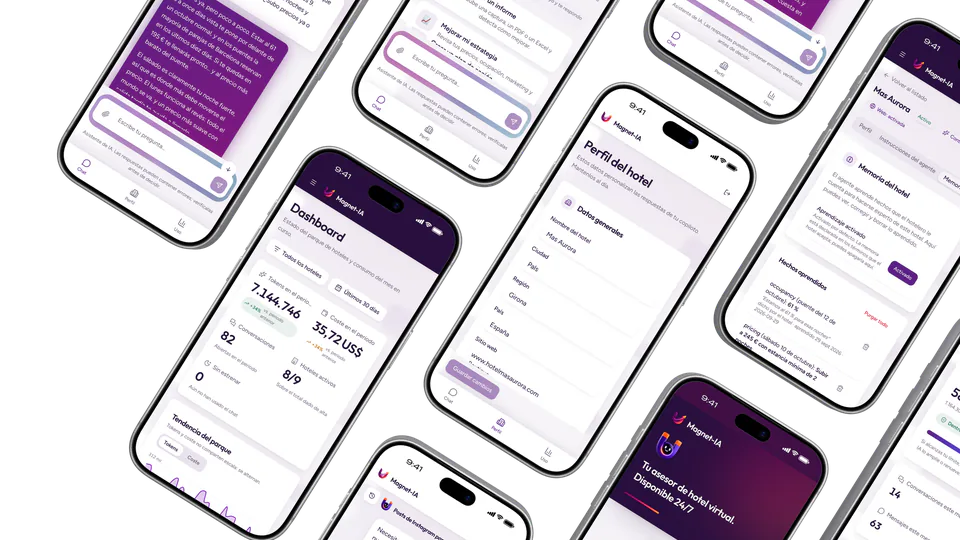
Magnet-IA was created so that boutique and independent hotels could draw on expert judgement in revenue management (pricing and occupancy) and marketing without setting up a department of their own. What we built was a copilot available around the clock: the AI knows each property, reads its reports and suggests concrete actions in plain language, in whatever language the hotelier writes in.
Start with the quarterly emails
The first version does not have to be a training plan for the whole company. At Carmen's practice it could be the task that comes up most each quarter: the emails asking every client for their invoices and receipts. Álex shows how to prepare them with the assistant, the others try it with their own clients and, once it works, the next task is added.
If you would like to see how it would work for you, our free workshop, in Spanish, walks through it step by step.
Frequently asked questions
What does the Bank of Spain say about AI in small businesses?
According to a Bank of Spain study published on 28 October 2026, AI use among Spanish SMEs has doubled since 2024 and stands at between 30% and 35%, depending on the technology, compared with around 70% at large companies. Among SMEs already using it, occasional or experimental use is the most common pattern.
Do I need to hire an AI expert to get started?
Not necessarily. According to the Bank of Spain, only 17% of SMEs expect to hire more specialist staff over the next three years. An alternative is to train the team you already have: pick a few recurring tasks, have whoever already uses the tool show the others, and set aside a regular slot to practise on real cases.
How do you train a small team in artificial intelligence?
Through everyday work. Choose two or three recurring tasks everyone knows, practise on real cases rather than textbook examples and agree a few simple rules: which client data never goes into the tool, and who checks what it produces before it is sent. After a few weeks, review who is using it and for what, and build from there.
Why does using AI only now and then deliver so little?
The Bank of Spain puts figures on it: among firms making moderate use of generative AI, close to 40% see productivity gains, against 14% of those that only use it occasionally. Using it regularly on specific tasks is how people learn what to ask and how to check its answers, which a one-off try does not give you.
Will AI cost jobs at my company?
The Bank of Spain's data point to a limited effect so far: close to 89% of firms already using AI see no significant effect on jobs over the past three years. For the next three, around 8-9% of SMEs expect their headcount to grow and a similar share expect it to shrink.
Sources
About digizone
digizone is a custom software development company founded in 2019, with offices in Barcelona and Cartagena (Spain). We design and build mobile apps, web applications, CRM/ERP systems and AI automation for startups, SMEs and enterprises. Meet the team

Other articles
Don't get left behind: if you want to keep up to date with the fast-moving technology sector, take a look at the following articles:

PHP vulnerability: what to check if you use WordPress
PHP has fixed two critical flaws, found with the help of AI, that let attackers take over a website. What to ask your hosting provider today if you use WordPress.
Read more »
AI shopping agents: your shop has to be readable too
Walmart is opening its store to AI shopping agents that search and buy for customers. What it means for a small online shop and what to check on your site.
Read more »
GPT-4o retirement: what to check if your business uses it
OpenAI will retire GPT-4o and GPT-4.1 from its API on 14 January 2027. If a tool or automation in your business relies on them, here is what to check.
Read more »Contact us
Do you have any questions? Would you like to schedule a call or a meeting? We would be happy to address any concerns and start working with you. The perfect digital solution for your business is just around the corner.
Subscribe to the newsletter
Discover the digital future by subscribing to our exclusive newsletter! Stay updated on the latest trends and developments in the world of technology. Don't miss the chance to be the first to learn about the innovations that are transforming the present! Subscribe now.