
Meta's new AI agent for small businesses needs your data
Meta has launched Muse for Small Business, an AI agent that reads a company's own tools. Why well-organised business data matters more than the agent itself.

Blog · · 6 min · digizone team
Meta has launched Muse for Small Business, an AI agent for small businesses that plugs into the tools a company already uses and can analyse sales, spending and campaigns or draft messages. For a small firm, the agent matters less than what it will be able to read: it only works with the data held in those tools. If sales, costs and customers are spread across notebooks and chats, getting them in order comes first.
In short
- On 29 September Meta unveiled Muse for Small Business, an AI agent for small firms that connects to tools such as Shopify, Stripe, QuickBooks and Slack.
- According to Help Net Security, Muse launched in September in the US and Canada; it is free with usage limits, with paid plans for heavier use.
- An AI agent can only analyse what sits in your tools: anything kept in notebooks, scattered chats or someone's head is left out.
- Before choosing an agent, it pays to sort out where sales, costs and customers live, and to make sure those systems talk to each other.
What Meta has announced
An AI agent is an assistant that does not just answer questions but can carry out tasks for you inside other software. On Tuesday 29 September Meta said it was extending its Muse agent to small businesses. It can read Instagram professional account analytics, Facebook Pages and Meta ad accounts, and connect to software such as Shopify, Stripe, QuickBooks, Slack, Canva, Notion and Zoom, among others, according to TechCrunch. The same report says it is free with usage limits, with paid plans for those who need more.
With that data, Meta says Muse can analyse sales, campaigns and social activity to draft a growth plan, review the accounts for unusual expenses, spot which ads are working and flag emails that need a reply, Help Net Security reports. The same outlet notes two caveats: Meta says nothing is published, sent or spent without the user's approval, and Muse launched in September in the US and Canada. None of the sources says when it will reach other countries.
A Tuesday in a pottery studio

Picture a small pottery studio that also sells online. Web orders sit in the online shop. Commissions arrive through Instagram messages and WhatsApp. The cost of clay, glazes and postage goes into a spreadsheet whenever someone remembers, and the receipts pile up in a box.
One Tuesday the owner asks a simple question: which pieces actually make money, and which just make work? Answering it means opening four different places, copying figures by hand and matching them up. It gets pushed to Sunday. On Sunday it does not happen either.
Why does a small firm's data end up scattered?
The scene is made up, but we have seen it in many guises. Small businesses grow through quick fixes: an online shop because they needed to sell, a spreadsheet to keep costs to hand at the end of each quarter, WhatsApp because that is where the customers are. Each tool does its own job and none of them talks to the others.
On top of that, much of what matters never gets written into any system at all: the special price for a loyal customer, the supplier who is always late, the order agreed over the phone. That knowledge lives in the owner's head.
What an AI agent cannot see

This is the cost the news brings into view. An agent like Muse works with whatever it finds in the connected tools. If sales are in one place, costs in another and customer agreements nowhere at all, the analysis it hands back will be as patchy as the data behind it. It could suggest a growth plan without knowing which products lose money.
And the cost does not start with AI. You are already paying it, in hours spent copying figures between systems, in decisions made on gut feeling and in questions left unanswered because joining up the data takes too long. An agent can speed up a lot of that work, but only on top of tidy data.
How can a small business get ready for an AI agent?
There is no need to wait for Muse, or any other agent, to reach your country before preparing. What helps with any agent is having the business's information in tools that can be connected. This order tends to work:
- List where each piece of data lives: sales, payments, costs, customers, orders and stock. Note what exists only on paper or in your head.
- Pick one main home for each type of data and stop copying it into stray spreadsheets.
- Check that your software can connect to other tools. If one cannot, that is your weak spot.
- Bring the essentials together in a dashboard you look at every week, even if it starts with three figures.
- Once that works, try an AI agent on that data, with one specific question, and review every suggestion before acting on it.

For the pottery studio, that might mean bringing the online shop, the cost spreadsheet and the commissions into a single tool. Then the question of which pieces make money can be answered in minutes, whether the owner asks it or an agent does.
How we help at digizone
At digizone we build custom CRM and ERP software: management tools that bring customers, sales, hours and costs together in one place and connect to the software you already use. We start by understanding how your team works and build the tool around that.
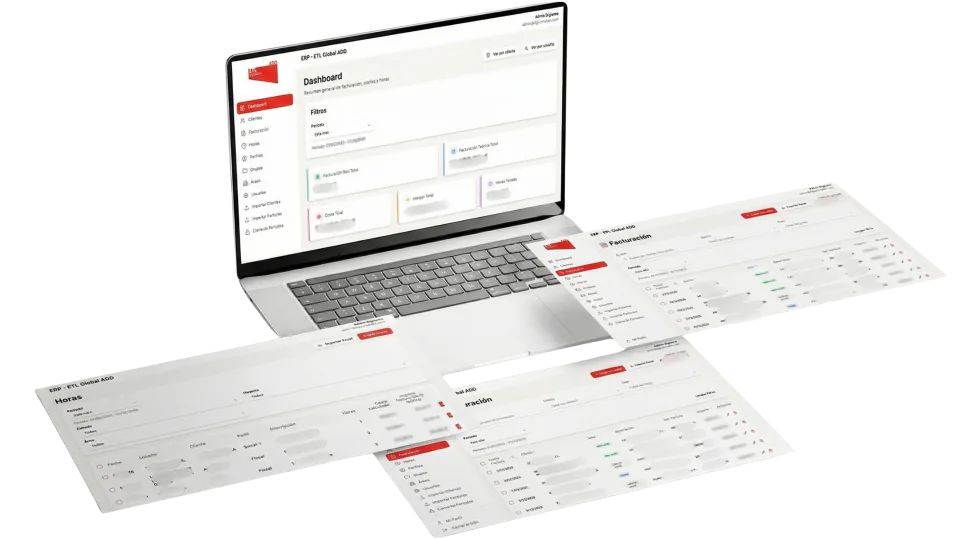
One example is ETL. Information on hours, clients, roles and invoicing was scattered across different systems, which made it hard to tell which projects were profitable. We built a custom web ERP that imports the data they already held in Access, records hours by client and project, works out the costs and links them to invoicing. Management now sees client and project profitability on live dashboards. It is the kind of well-ordered foundation on which any analysis, with or without AI, makes sense.
Start with a first version
Getting a business's data in order does not have to be one big project. The MVP idea, a minimum viable product, applies here too: build the smallest thing that already solves a real problem, such as a dashboard that puts sales and costs side by side, and use it from day one.
For the pottery studio, that first version would be a dashboard that reads the online shop and the cost spreadsheet and shows, piece by piece, what is left after materials and postage. Then the Instagram and WhatsApp commissions are added, and later the stock. Every figure that finds its proper home is one more an agent can read, whether that is Muse or another.
If you would like to see how it would work for you, our free workshop, in Spanish, walks through it step by step.
Frequently asked questions
What is Meta's Muse for Small Business?
It is a version of Meta's Muse AI agent built for small businesses, announced on 29 September 2026. It connects to Instagram, Facebook, Meta ad accounts and software such as Shopify, Stripe, QuickBooks and Slack, and can analyse sales, spending and campaigns or prepare drafts. Meta says nothing is published, sent or spent without the user's approval.
Can businesses in Spain or the UK use Muse for Small Business?
According to Help Net Security, Muse launched in September 2026 in the US and Canada, and the sources we consulted do not say when it will reach other countries. In the meantime, a business elsewhere can prepare by organising its data in connected tools, which will help with this agent or any other AI agent it decides to use.
How much does Muse for Small Business cost?
According to TechCrunch, Muse for Small Business is free with usage limits, and Meta offers paid subscription plans for businesses that need to use it more. The sources we consulted give no specific prices for those plans, so it is worth checking the official terms once it is available in your country before relying on it.
What does a small business need to get value from an AI agent?
Above all, organised and accessible data. An AI agent only analyses what it finds in the connected tools, so sales, payments, costs and customers should sit in software that can be linked up, without duplicates in stray spreadsheets. With that foundation, the agent can answer specific questions about the business.
Do I need an ERP to use an AI agent?
Not necessarily. Many agents connect directly to an online shop, accounting software or email. A custom ERP or CRM makes sense when information is spread across many places or when the way you work does not fit generic software, because it brings the data into one place and makes it easier to connect.
Sources
About digizone
digizone is a custom software development company founded in 2019, with offices in Barcelona and Cartagena (Spain). We design and build mobile apps, web applications, CRM/ERP systems and AI automation for startups, SMEs and enterprises. Meet the team

Other articles
Don't get left behind: if you want to keep up to date with the fast-moving technology sector, take a look at the following articles:

Only 4.1% of Spain's industrial SMEs use AI: how to start
The IndesIA Barometer 2026 finds that just 4.1% of Spain's industrial SMEs use artificial intelligence. What it means and where to start.
Read more »
How mobile apps improve your business performance
Businesses in this era are increasingly turning their attention towards mobile apps for the improvement of their business process, overall performance, and customer engagement.
Read more »
How to define your target audience and get it right
Following the social media revolution, companies are now closer than ever to communicating with the right audience in the easiest and most effective way.
Read more »Contact us
Do you have any questions? Would you like to schedule a call or a meeting? We would be happy to address any concerns and start working with you. The perfect digital solution for your business is just around the corner.
Subscribe to the newsletter
Discover the digital future by subscribing to our exclusive newsletter! Stay updated on the latest trends and developments in the world of technology. Don't miss the chance to be the first to learn about the innovations that are transforming the present! Subscribe now.